



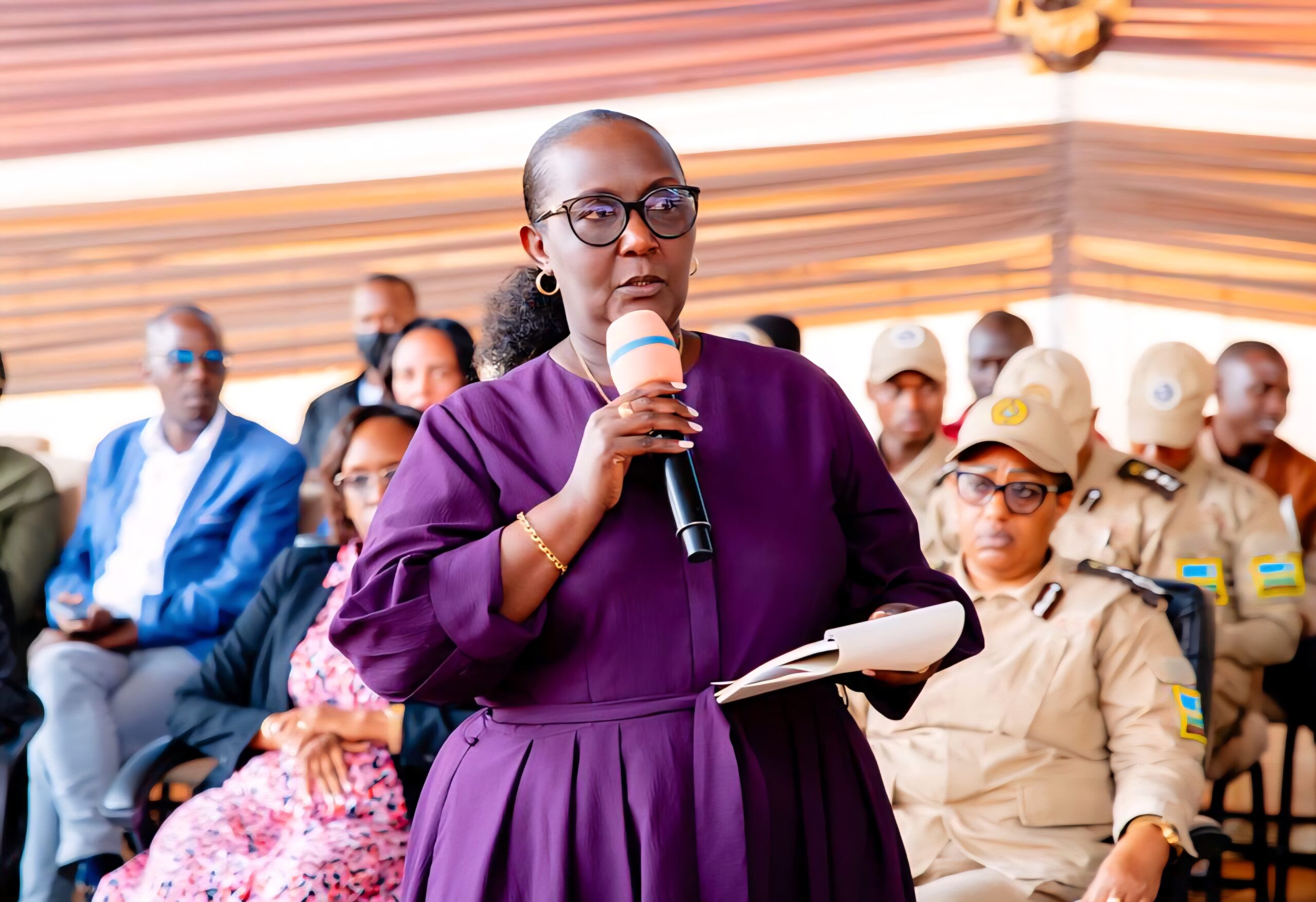
Chief Justice Domitilla Mukantaganzwa speaking in Nyarugenge prison (Mageragere) on Thursday November 13, 2025.
Chief Justice Domitilla Mukantaganzwa has revealed that out of 1,000 appeal cases reviewed by the courts, only about two are found to have valid grounds.
She says this extremely low number is a clear reason why Rwanda is promoting plea bargains as a faster and more effective way to resolve cases.
Pre-trial detainees now make up 18–20% of the national prison population. This has led several justice-sector organisations to support the plea bargain scheme, saying it can reduce unnecessary delays and free the courts to focus on cases that genuinely require a full trial.
This past week, Mukantaganzwa led a plea bargain sensitization campaign at Nyarugenge Prison.
She said all institutions involved in the justice chain—from investigation to trial—continue to meet the legal standards of due process.
The Chief Justice has also strongly criticized a common behaviour known as “Ndanze.”
This is when suspects refuse any form of early intervention and instead insist on going to court, even when the facts of the case are clear and the outcome is predictable.
The Chief Justice also pointed out another trend called “Reka Dehangane.” In these cases, neither side in a dispute wants to compromise, even for minor offences that could be settled quickly.
She said these habits unnecessarily waste court time and delay justice for other people.
Mukantaganzwa noted that integrity is a personal decision.
“You don’t have to commit crime to live a proper lifestyle,” she said. “Rwandans live at different levels, but there is no link between having plenty and living well. Many ordinary Rwandans live happily without a criminal background.”
To illustrate her point, the Chief Justice referred to an old survey done by RAFIKI youth magazine. The survey highlighted a person considered to be of high integrity by the public — a primary school teacher named Karangwa Stanislas from St Famille School.
She stressed that the magazine did not choose ministers or high-profile figures, but an ordinary teacher, showing that integrity has nothing to do with status.
Government data released in October shows that Rwanda has 74,253 inmates across more than ten prisons. Of these, 68,944 are men, 4,773 are women, 516 are boys under 15, and 20 are girls.
While some prisons are more crowded than others, the national occupancy average stands at 110%.
Mukantaganzwa dismissed claims that plea bargaining is meant to lower the prison population.
“We are not short of space to house convicted criminals,” she said. “Even during genocide cases, many suspects believed they would never be jailed because the numbers were too large. But justice was delivered.”
She said the true purpose of plea bargaining is to promote accountability, reduce delays, and allow courts to dedicate more time to complex cases — especially since so few appeals have merit.
