



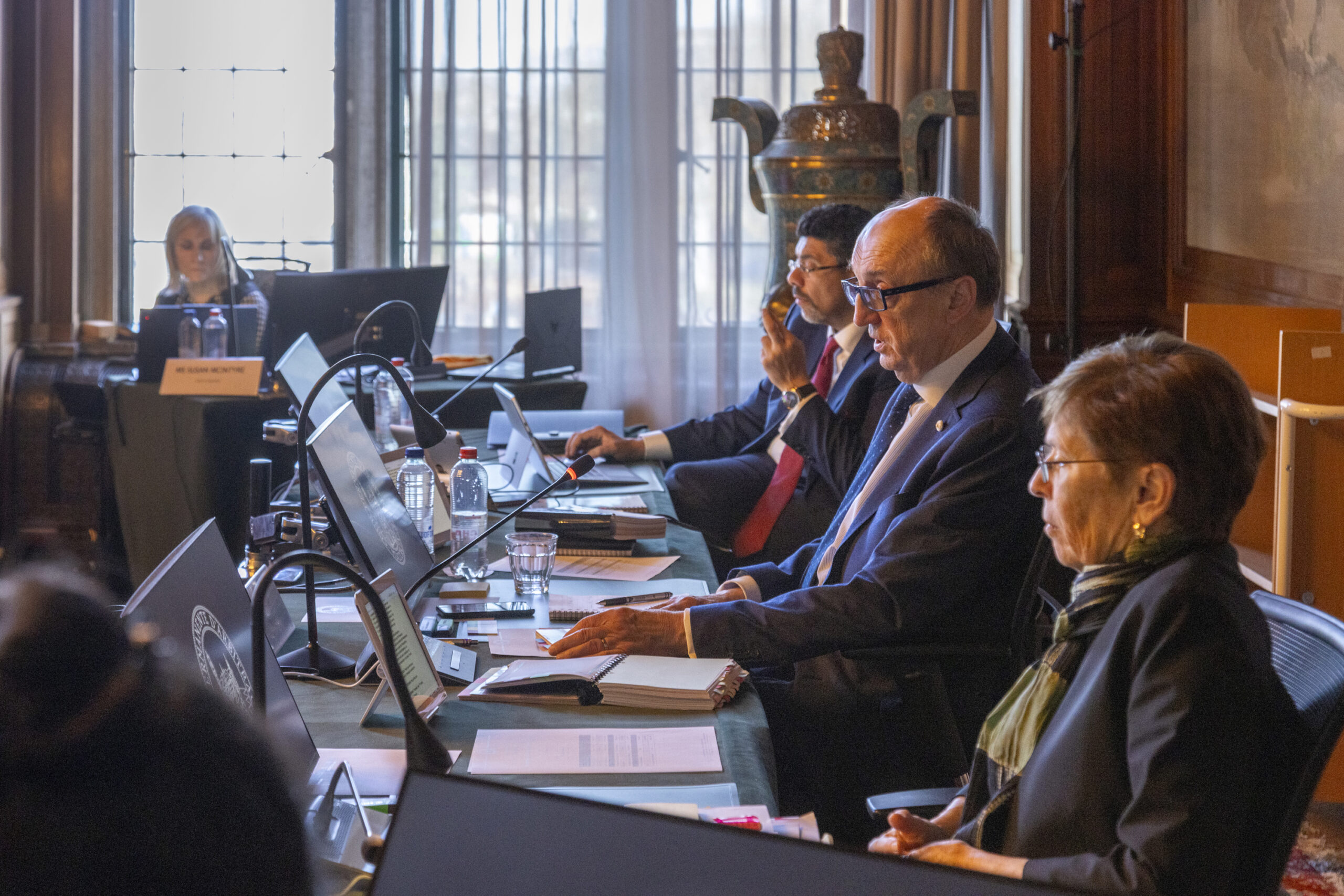
The three-Judge bench: Judge Peter Tomka (Chairperson in center, Professor Dr Mohamed Abdel Wahab (on right) and Judge Joan Donoghue (foreground)
This Monday, the Permanent Court of Arbitration, an international court ruled that Rwanda lost its claim to £100 million from the United Kingdom. The money was part of a now-dead asylum deal between the two countries.
But here’s the twist: one of the three judges strongly disagreed with the ruling.
What Was the Fight About?
Back in June 2024, the UK and Rwanda signed a binding agreement. The UK promised to pay Rwanda £50 million in April 2025 and another £50 million in April 2026.
Then things fell apart. The UK’s new prime minister said the Rwanda asylum plan was “dead and buried.” The UK asked Rwanda to give up the future payments.
In November 2024, Rwanda sent a note back saying the “proposed arrangements are acceptable.”
The UK said: “See? You agreed. No more money.”
Rwanda said: “No, we didn’t. We just said we’re open to talking about it.”
What the Majority Said (Why Rwanda Lost)
Two of the three judges (from Slovakia and the United States) ruled in favor of the UK. They said the November 2024 exchange of notes was a binding legal agreement. In their view, Rwanda agreed to give up the £100 million.
The third judge, Professor Mohamed Abdel Wahab from Egypt, wrote a detailed dissenting opinion. Here are his main points in plain English:
1. “Agreeing to talk” is not the same as “legally agreeing.”
There’s a huge difference between saying “okay, let’s discuss that” and saying “yes, I am legally bound.” The majority mixed these two things up.
2. The UK called its own note “political.”
Just days before the exchange, a UK official sent an email calling the document a “short political NV” (political note). You can’t call something political and then later claim it’s a binding legal contract. Rwanda took the UK at its word.
3. Look at June vs. November — totally different.
Back in June 2024, when the two countries made a REAL binding agreement, Rwanda’s note was a perfect copy of the UK’s note. It said: “this records our understanding” and “this takes effect today.”
In November, Rwanda’s note said none of that. Just the word “acceptable.” That’s a huge red flag. If Rwanda meant to make a binding deal, why would they change their language so completely?
4. The money and the visa deal were tied together.
The UK’s own internal emails admitted that the £50 million payments and a visa deal for Rwanda were “inextricably linked” (tightly connected). Rwanda was never going to give up the money for nothing. But the visa deal never happened. So why would Rwanda give up the cash?
5. You can’t create a contract backwards.
When Rwanda later said “we rescind this” (we take this back), the majority said: “Aha! That proves it was a real agreement!” The dissenting judge says that’s backwards thinking. A later statement cannot magically create a legal agreement that didn’t exist in the first place.
What Rwanda Said After the Ruling
Rwanda’s government spokesperson, Yolande Makolo, released a very careful statement. Here’s what she said, broken down: “While Rwanda respects the Tribunal’s award and considers the matter concluded…”
“…we note that the dissenting and separate opinion by Professor Mohamed Abdel Wahab shows that the issues before the Tribunal were complex and open to different legal conclusions…”
“…including that the November 2024 exchanges relied on by the UK did not validly change the financial arrangements between the two countries.”
Translation: The dissenting judge said we never actually agreed to give up the money. That matters.
“Rwanda will continue to work constructively with international partners, guided by international norms and mutually beneficial cooperation.”
So Did Rwanda Win or Lose?
On money: Lost. Rwanda doesn’st get the money.
On reputation: Won. Rwanda can point to a respected judge’s opinion saying they acted correctly and never signed away their rights under pressure.
Think of it this way: Imagine you’re accused of breaking a promise. A jury says you’re guilty. But one of the jurors writes a long report saying, “Actually, I don’t think s/he ever made that promise in the first place.” You still have to pay the fine. But you can show that report to anyone who questions your honesty.
That’s where Rwanda sits today. They lost the cash. But they won the honesty story.
