For 31 days, the world will live extraordinary moments.
A goal scored in New York will trigger celebrations in Kigali. A dramatic penalty save in Mexico City will leave millions holding their breath in Nairobi, Tokyo, Buenos Aires, and Casablanca. Complete strangers, separated by oceans, languages, and cultures, will experience the same joy, the same heartbreak, and the same hope at precisely the same moment.
No passport is required. No common language is needed. Only football.
As the 2026 FIFA World Cup approaches, the world is preparing for more than a tournament. It is preparing for the greatest celebration of humanity ever staged through sport.
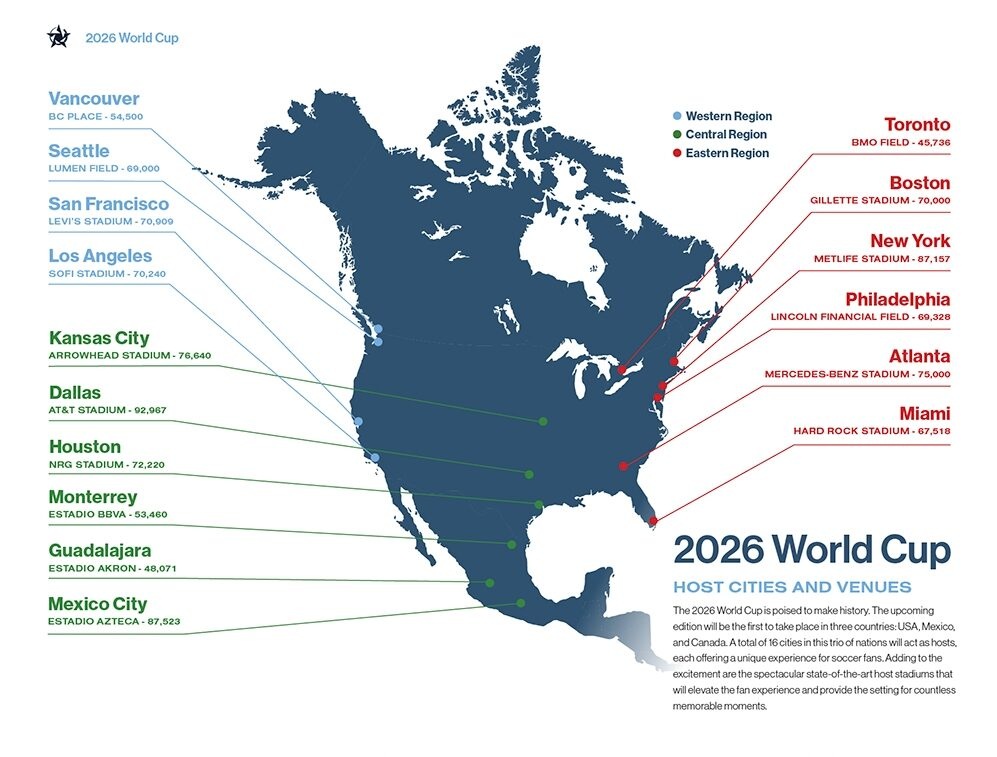
Hosted across three nations — the United States, Canada, and Mexico — the 2026 FIFA World Cup will be unlike any before it. For the first time in history, 48 teams will compete for football’s most coveted prize, making it the largest World Cup ever staged.
From the iconic stadiums of New York and Los Angeles to the vibrant football cities of Mexico and Canada, the tournament will stretch across an entire continent, bringing together millions of fans and billions of viewers.
For one month, football will achieve what politics often cannot. It will bring billions of people together under a shared emotion. Rivalries will exist, flags will wave proudly, and national anthems will echo through packed stadiums. Yet beneath the competition lies something deeper: a reminder that the things that unite us are often greater than the things that divide us.
The World Cup is one of the rare events capable of stopping the world in its tracks. Children will rush home from school to watch matches. Families will gather around television screens, and friends will fill cafés and viewing centres. Social media will explode with celebrations, debates, predictions, and unforgettable moments.
For millions of people around the world, sleep schedules will change, daily routines will shift, and entire days will revolve around ninety minutes of football.
And nobody complains.
Because the World Cup is not merely watched; it is lived.
Every edition writes stories that outgrow sport itself. Unknown players become national heroes. Underdogs become giant killers. Small nations capture the imagination of the world. Moments lasting only seconds become memories carried for generations.
In 2026, those stories will be bigger than ever. Forty-eight nations will arrive carrying their hopes, their cultures, their songs, and their stories. Every team will represent the pride of millions of people back home.
For Argentina, it may be another chance to defend a legacy built by legends.
For Brazil, it will be a pursuit of footballing greatness.
For France, Germany, Spain, England, Morocco, Senegal, Japan, and many others, it will be an opportunity to write a new chapter in their national story.
And that is what makes the World Cup beautiful.
The 2026 tournament may also mark the final World Cup chapter for some of football’s greatest icons.
Lionel Messi, who fulfilled a lifelong dream by lifting the trophy at the 2022 FIFA World Cup, could make one last appearance on football’s grandest stage.
Cristiano Ronaldo, whose name has become synonymous with excellence and longevity, may also be chasing one final World Cup dream.
Yet the World Cup has always been about more than legends.
It is where new heroes are born.
A young player unknown to the world today could become the face of the tournament tomorrow.
That is the magic of football.
One ball.
Forty-eight nations.
Eight billion dreams.
And for one unforgettable month, the world will become one.